

The world of healthcare has always stood on a sacred foundation: a patient shares their most personal truths, and a doctor safeguards them. For decades, this trust was protected by ethics and tradition. Today, it must also be protected by law.1
India’s Digital Personal Data Protection (DPDP) Act marks a turning point. For most industries, it’s a compliance update. For healthcare, it’s a fundamental shift in responsibility, accountability, and daily practice.
Because healthcare doesn’t just handle personal data. It handles sensitive personal data — the kind that reveals illness, identity, emotion, vulnerability.2 The kind patients expect to be guarded like a temple treasure.
This 3-part article breaks down the DPDP Act in simple, clinic-focused terms and shows how doctors, clinics, and healthcare businesses can prepare — without fear, without jargon, without disruption.
Why DPDP Hits Healthcare Harder Than Any Other Sector
Most clinics don’t realise how much patient information moves through their ecosystem every single day:
- OPD registration forms
- WhatsApp conversations
- Diagnostic reports
- Prescriptions
- EMR entries
- Lead forms
- Promotional messages
- Appointment reminders
- Staff communications
- Old spreadsheets and patient lists
Each one is a data point, and under DPDP, every data point comes with responsibility.
Healthcare isn’t like retail or hospitality. A clinic handles information that speaks to the core of a person’s life — their health. Because of this, clinics are expected to maintain higher standards of care in how they collect, handle, store, and share information.3
The penalties for mishandling digital personal data are significant, but the real cost is deeper: damage to patient trust.
What the DPDP Act Actually Means (Explained Simply)
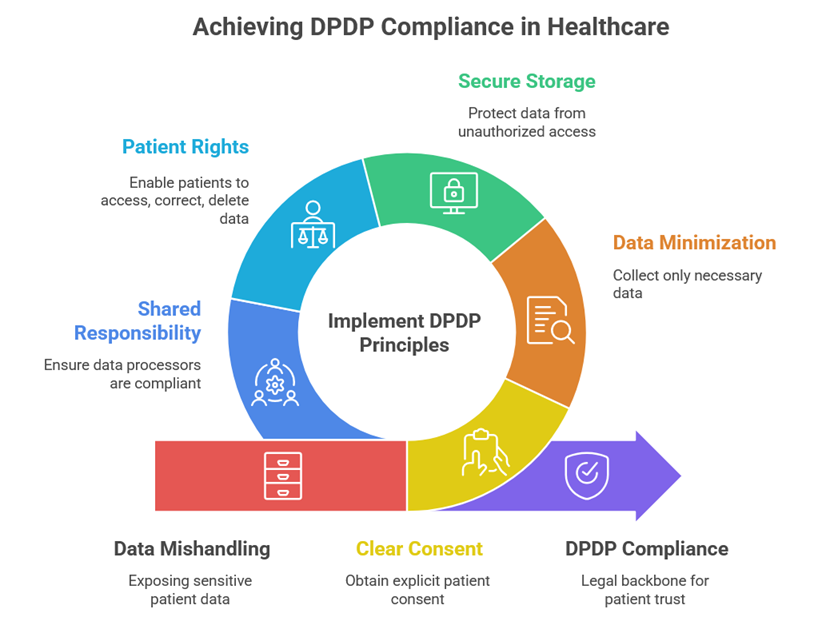
The Act is built on a few clear principles — easy to understand, powerful in impact:
1. Consent must be clear & purposeful
Patients must know:
- What data is being collected
- Why it’s being collected
- How it will be used
- Whether it will be used for reminders or marketing
- How they can withdraw consent
The old model of “implied consent” is fading. 4 Under DPDP, if consent is vague, it is not consent.5
Case Example: The Blurred Consent
A patient fills out a physical form for a dental procedure, signing a single clause for "treatment consent." The clinic later uses their phone number to send marketing messages for cosmetic facial fillers offered by a partner clinic. Under DPDP, the original signature only covered treatment. The clinic is now in violation because they failed to obtain separate, specific, and clear affirmative consent for marketing or third-party sharing.
2. Collect only what you need
If a clinic doesn’t need the data for treatment or operations, it should not collect it.6 Less data → lower risk.
Case Example: Data Overreach
A physiotherapy clinic's online booking form asks for the patient's Aadhaar Number and Mother's Maiden Name. Since the clinic only needs name, contact, and injury details to book an appointment, collecting highly sensitive identifiers like an Aadhaar number is a violation of the Data Minimisation principle.
3. Store securely, access carefully
Data must be:
- Stored safely
- Accessible only to authorised staff1
- Protected from casual sharing
- Deleted when no longer needed8
A shared computer, an unprotected spreadsheet, even a receptionist’s personal phone can become vulnerabilities.
A small pathology lab saves a consolidated monthly spreadsheet of all patients (names, test results, mobile numbers) on a shared desktop computer that is accessible to all administrative staff without a password or role-based restriction. When a temporary intern accidentally emails the list to a wrong vendor, the lab faces a data breach notification requirement and a penalty for failing to protect the data with reasonable security safeguards.
4. Patients have rights
Patients can ask:
- “What data do you have about me?” (Right to Access)
- “Why do you have it?” (Right to Information)
- “Please update it.” (Right to Correction)9
- “Please delete it.” (Right to Erasure/Withdrawal)10
And clinics must be able to comply.11
5. Responsibility is shared — and that changes everything
The clinic is the Data Fiduciary (decision maker). But anyone who processes data for you — EMRs, call centres, form tools, marketing agencies — becomes a dp under the Act.
That means your risk is tied to the systems and partners you choose.
Case Example: The EMR Breach
A medium-sized hospital uses an external EMR vendor to manage all digital patient records. The EMR vendor’s server suffers a cyberattack due to an outdated security patch. Even though the hospital did not directly cause the breach, the hospital (the Data Fiduciary) is ultimately accountable for the breach and faces the regulatory penalty, alongside potential contractual liability against the EMR vendor.
This is the reality most doctors haven’t been told yet.
Conclusion: The Shift from Ethics to Accountability
The DPDP Act does not introduce new ethics to healthcare; it simply gives the existing standard of patient trust a legal backbone. For practices that are already diligent, it’s a matter of documentation and minor process refinement.
However, for those operating with outdated systems or implied consent models, the transition will be challenging. Understanding these principles—clear consent, data minimisation, and shared responsibility—is the first critical step toward compliance.
The true risk, however, lies not just in the law itself, but in the daily, often unconscious, errors that expose patient data.
What’s Next? The Hidden Risks You Must Address
Now that you know the rules, where are the weak points in your practice?
In Part 2: DPDP Act Healthcare Impact: The Hidden Risks Doctors Don’t Realise They’re Taking, we will move beyond the principles and explore the specific, high-risk scenarios and vulnerabilities present in every clinic—from the front desk to the billing software—and reveal the true cost of non-compliance.
[Part 2- DPDP Act Healthcare Impact: The Hidden Risks Doctors Don’t Realise They’re Taking]